
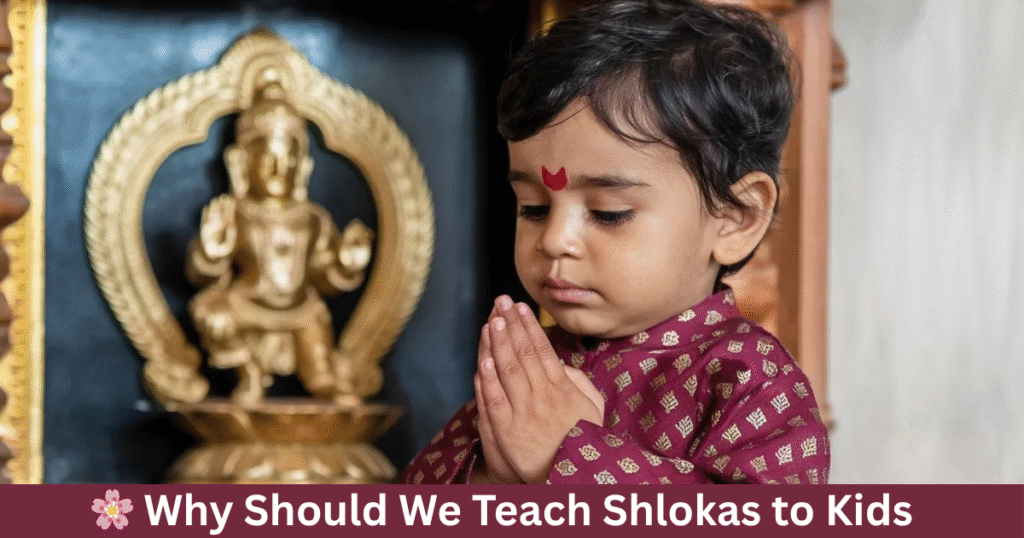
🌼 Introduction
In the age of technology, where children are surrounded by screens, video games, and fast-changing trends, many parents wonder how to preserve the roots of Indian culture. One of the most powerful and peaceful ways to connect children with Sanatan Dharma is by introducing them to shlokas — the sacred Sanskrit verses that carry divine vibration and ancient wisdom.
Teaching shlokas is not just about memorizing Sanskrit; it’s about shaping the child’s mind, morals, and soul. Shlokas strengthen concentration, improve pronunciation, and nurture values such as gratitude, discipline, and compassion.
At Sanatan Sanskaar Vidya Gurukulam, we believe —
“हर घर गुरुकुल, हर बच्चा संस्कारी”
“Every home should become a Gurukul, and every child a carrier of Sanskaar.”
🌺 What Are Shlokas?
A Shloka (श्लोक) is a sacred verse composed in Sanskrit, usually in the form of two lines or a rhythmic couplet. Shlokas are found in our Vedas, Upanishads, Bhagavad Gita, Ramayana, Mahabharata, and many other texts.
They are not mere words — each syllable of a shloka carries vibrations that influence our body, mind, and aura. When a child chants a shloka, their speech, breath, and thought patterns align in harmony.
🌸 Why Should We Teach Shlokas to Children?
- Spiritual Connection from Early Age
When children learn to chant “Om Namah Shivaya” or “Om Namo Bhagavate Vasudevaya”, they begin to connect with divine energy from a very young age.
This connection helps them develop faith, calmness, and gratitude.
Spiritual growth during childhood ensures that even when they grow up in a fast world, they remain rooted in inner peace and values.
- Shlokas Improve Concentration and Memory
Scientific studies show that chanting rhythmic verses improves the left and right brain coordination. The vibration of Sanskrit syllables enhances focus, attention, and memory retention.
Children who regularly recite shlokas often perform better in academics, especially in mathematics, reading, and logical reasoning.
🕉 Example:
“सह नाववतु। सह नौ भुनक्तु।
सहवीर्यं करवावहै।”
This simple peace mantra helps children stay calm and work together with cooperation and discipline.
- Purifies Speech and Improves Pronunciation
Sanskrit is called the language of vibration. Each letter has a scientific sound that balances energy within the body. When kids learn to pronounce words like “Shanti,” “Prana,” “Dharma,” their tongue and breath coordination improves, which also supports better pronunciation in other languages such as Hindi and English.
- Instills Moral and Ethical Values
Each shloka carries a moral lesson. For example:
“सत्यं वद, धर्मं चर।” – Speak the truth, follow righteousness.
When parents teach these to children, they are not just sharing words but planting values of honesty, kindness, and self-discipline.
At Sanatan Sanskaar Vidya Gurukulam, we encourage parents to learn along with their children so that the family as a whole grows spiritually.
- Reduces Anxiety and Anger
Chanting creates vibrations that balance the nervous system. When kids recite shlokas every morning, they begin their day with peace and focus. This helps reduce anxiety, hyperactivity, and aggression — especially important in today’s fast-paced school life.
- Brings Family Together
Imagine a home where parents and children sit together for five minutes daily to chant Gayatri Mantra or Hanuman Chalisa.
That moment becomes sacred — it connects generations, builds emotional bonding, and reminds children that spirituality begins at home.
“A family that prays together, stays together.”
🌷 Short Story: “A Home That Became a Gurukul”
Once there was a young couple, Raghav and Meera, blessed with an 8-year-old son named Arjun.
Arjun was brilliant but restless. He would spend hours on his tablet and often got irritated while studying.
One day, Meera attended a session at Sanatan Sanskaar Vidya Gurukulam, where she learned the importance of shlokas. She decided to try something new.
Every morning, she chanted with her son —
“Om Bhur Bhuvah Swaha,
Tat Savitur Varenyam…”
At first, Arjun just repeated the words. But slowly, his tone softened, his breathing became rhythmic, and he began to smile more.
Within a few weeks, his teachers noticed improvement — Arjun became more focused, polite, and confident.
The small ritual had transformed their mornings into peaceful family time.
Raghav too joined them, and soon, the whole family felt a deep sense of connection — not only with each other but also with God.
That day, their home truly became a Gurukul — a place of learning, peace, and sanskaar.
🌻 Role of Parents in Teaching Shlokas
- Lead by Example – Kids copy what parents do. Chant with them daily.
- Start Small – Begin with one or two lines like “Om Namah Shivaya” or “Guru Brahma